Cardiovascular deserts in Ohio from Lee Kirksey
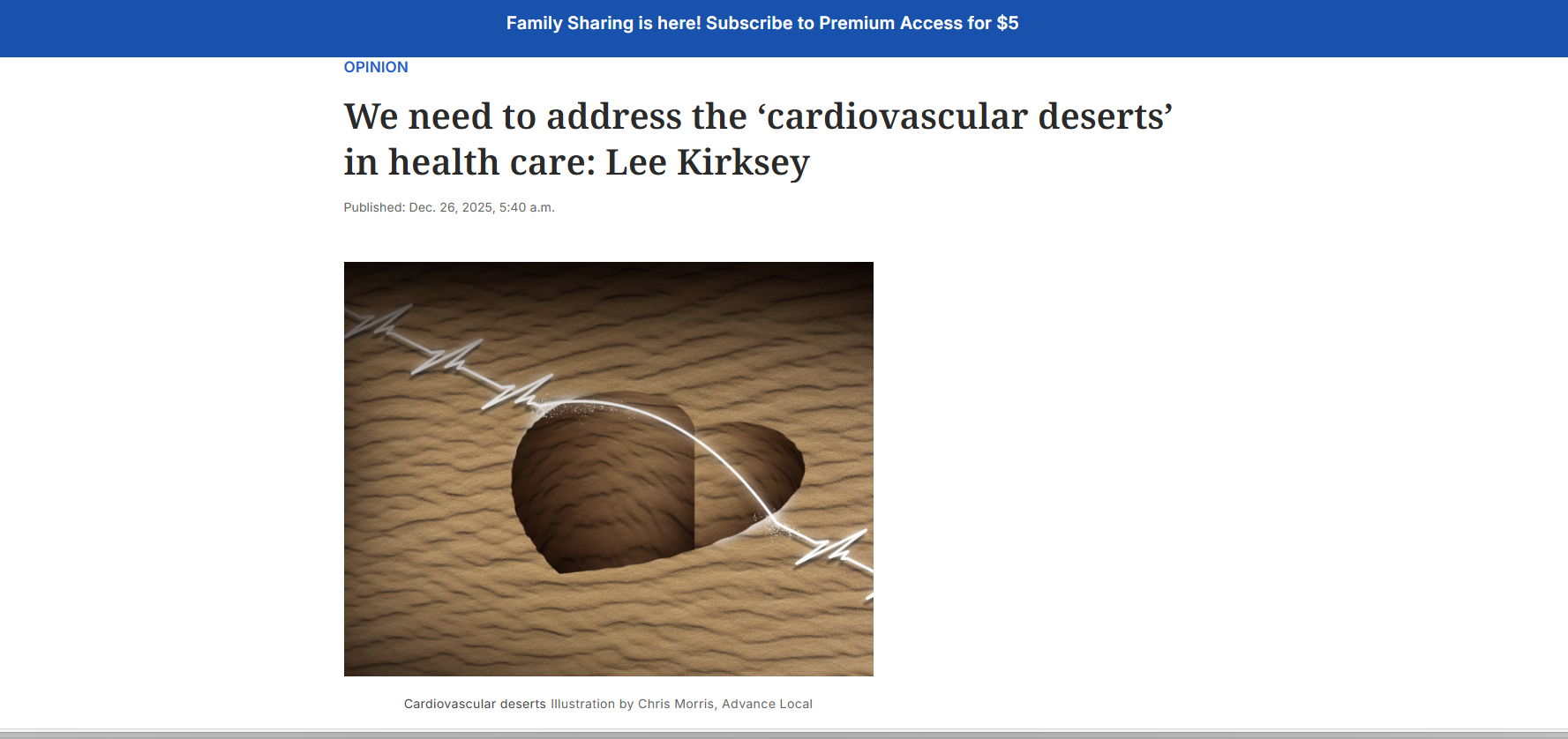
Cardiovascular disease is the number one killer in all communities. Low income, women, racial minorities and rural Americans experience higher prevalence of heart attack, stroke & limb loss. Obesity, diabetes, high cholesterol and smoking are the leading causational factors and reside at the confluence of systemic barriers like low health insurance rates.
The term Cardiovascular Desert (CVD) has been coined to describe geographic regions with low prevalence of cardiologists, PCPs and hospitals. Physical proximity to advanced specialty care is but one predictor of poor outcome and overall lower life expectancy.
As a person who grew up in the “hinterlands” of northeast Ohio-Alliance-I have personally witnessed the impact of rurality superimposed on other demographic indicators of health disparities. A community that is a “stone’s throw” away from academic medical centers on a map-to people from these communities-becomes long days of travel, missed days of work & lost wages. It’s not surprising that gaps in life expectancy between rural and metropolitan communities have been widening since the 1990s.
CVD’s did not develop in a vacuum. Ohio’s “rural death gap” corresponds to the exodus of manufacturing i.e., steel and automobile industry in 1990’s and the subsequent downward economic spiral. Political consultant James Carville famously stated, “It’s the economy stupid!”.
Physical distance is not the only determinant of this phenomenon. Deserts exist within metropolitan communities most commonly when a confluence of political will, policy and socioeconomic drivers have rendered areas void of healthcare services.
Recent Federal legislation leaves me cynical that help is on the way for vulnerable rural communities.
First, recent policy detrimentally impacts cardiovascular deserts. The One Big Beautiful Act [OBBA] (Public Law 119-21) signed into law on July 4, 2025 reduces federal spending on Medicaid by $900 billion over the next 10 years. Through new burdensome administrative enrollment and work requirement, the American Medical Association expects that 10 million people will lose coverage through loss of Medicaid, Affordable Care Act subsidies and Children’s Health Insurance Program.
OBBA also eliminated the Grad Plus Loan program which allows medical students to borrow up to the full cost of tuition and living expense. This change will lead to fewer applications by students from lower income families worsening existing physician shortages. Research confirms that students from low income and rural communities are more likely to return to these communities to practice. Moreover, reductions in Medicaid funding are expected to result in more rural hospital closures.